A Big Worldview: Global Power in 2026
Pundit after pundit is questioning Trump’s invasion of Venezuela. I’m so past that: This is what we should be focusing on, right now.
Our global order rests on implicit contracts between governments and their governed. These compacts, forged through centuries of trial, catastrophe, and adaptation, determine how the world's most consequential powers operate internally—and project externally. As January 2026 opens with American forces occupying Venezuela and announcing plans to "run" the country, understanding these foundational arrangements has become urgent, not academic.
The United States: Government by Consent—Under Strain
The American premise is revolutionary: sovereignty derives from the people, delegated to elected representatives (not unelected functionaries like Musk, Miller, Vought – who couldn’t win an election if they tried) with specialized competence in governance. The Founders designed institutional checks against corruption, fears that run through the Federalist Papers in Madison’s studied critiques of monarchical systems and their abuses around the world. If there was any author whose fears ran deep about unchecked power more than the others, it was Madison.

Those fears have materialized. The Trump administration has operated what experts and historians call an unprecedented influence apparatus. The president's cryptocurrency ventures have generated an estimated $800 million in family income, with holdings valued at billions. Foreign interests seeking favorable treatment invest directly in presidential businesses: a $2 billion deal routed through the family's stablecoin, SEC investigations halted after defendants purchased Trump crypto.
Inauguration donations reached $248 million, quadruple any predecessor, with donors receiving regulatory relief and dropped investigations. Pilgrim's Pride gave $5 million and received safety waivers. Boeing donated and avoided prosecution for 737 Max crashes. The crypto industry contributed $16 million and got a friendly "crypto czar" plus inclusion of donor tokens in the government's digital reserve.
Yesterday, in my podcast to all of you, I called it “pay to play.” Bribe Trump, you’re in. But make sure you compliment him on at least three things before you depart the room, and grovel in his presence, because he likes it. That’s what Kings do.
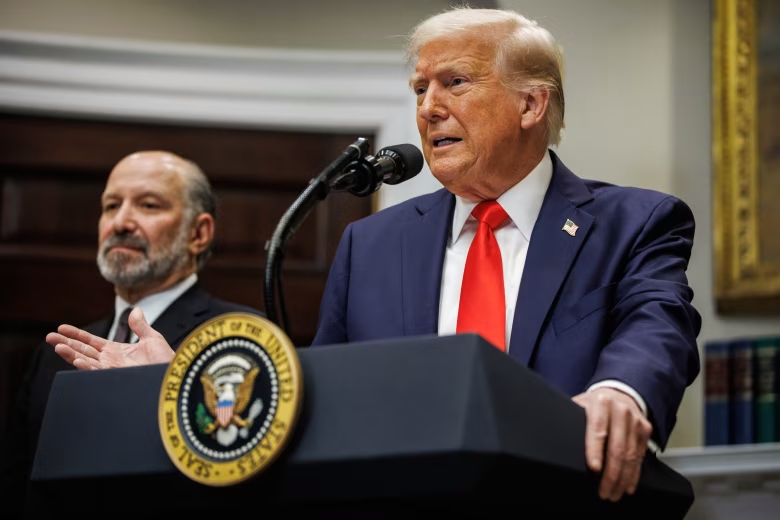
Now, Venezuela. On January 3, 2026, American forces captured President Maduro without congressional authorization. Trump announced the U.S. would "run" the country and "get the oil flowing." American major leaders have sought Venezuelan access for decades.
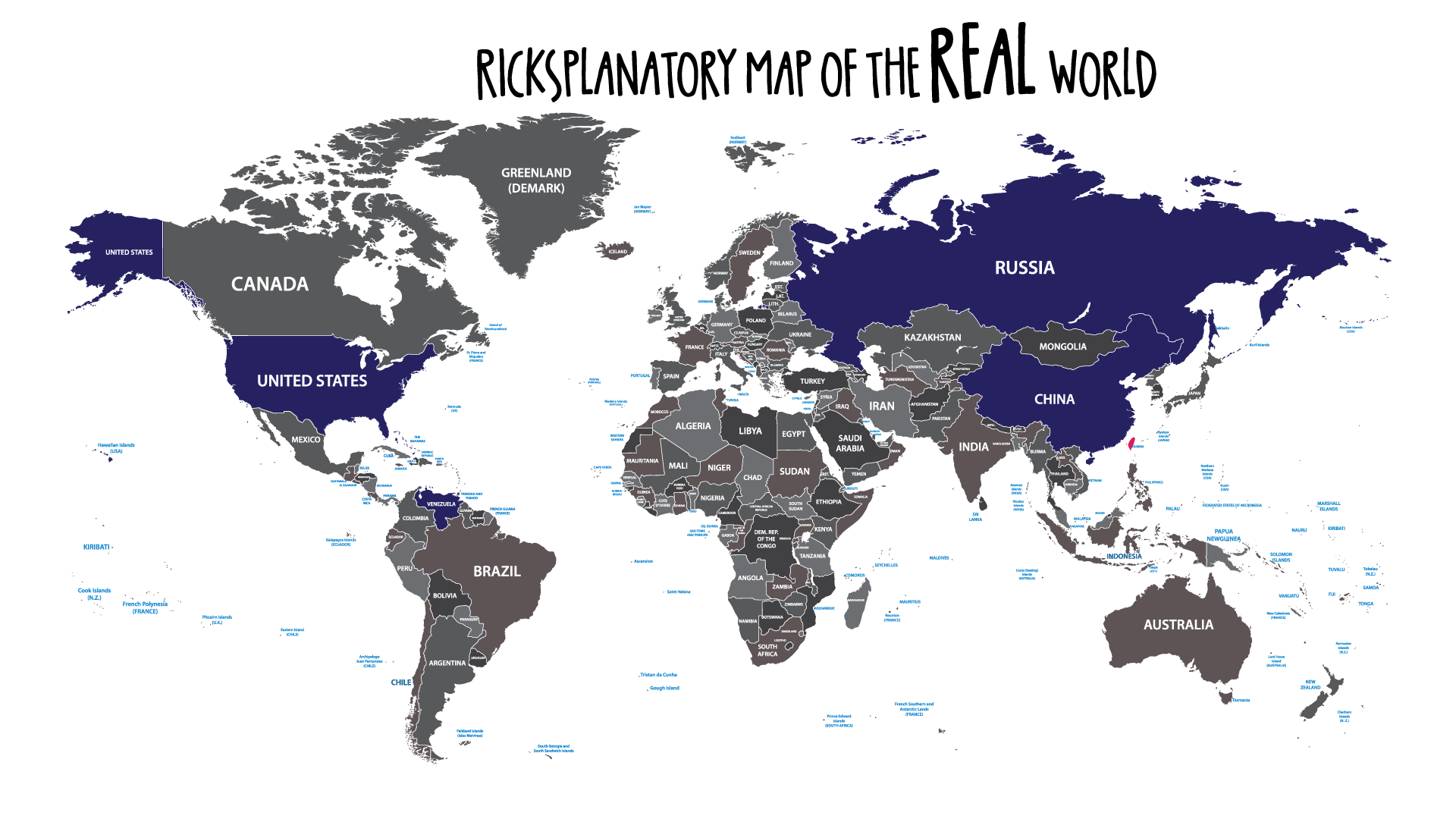
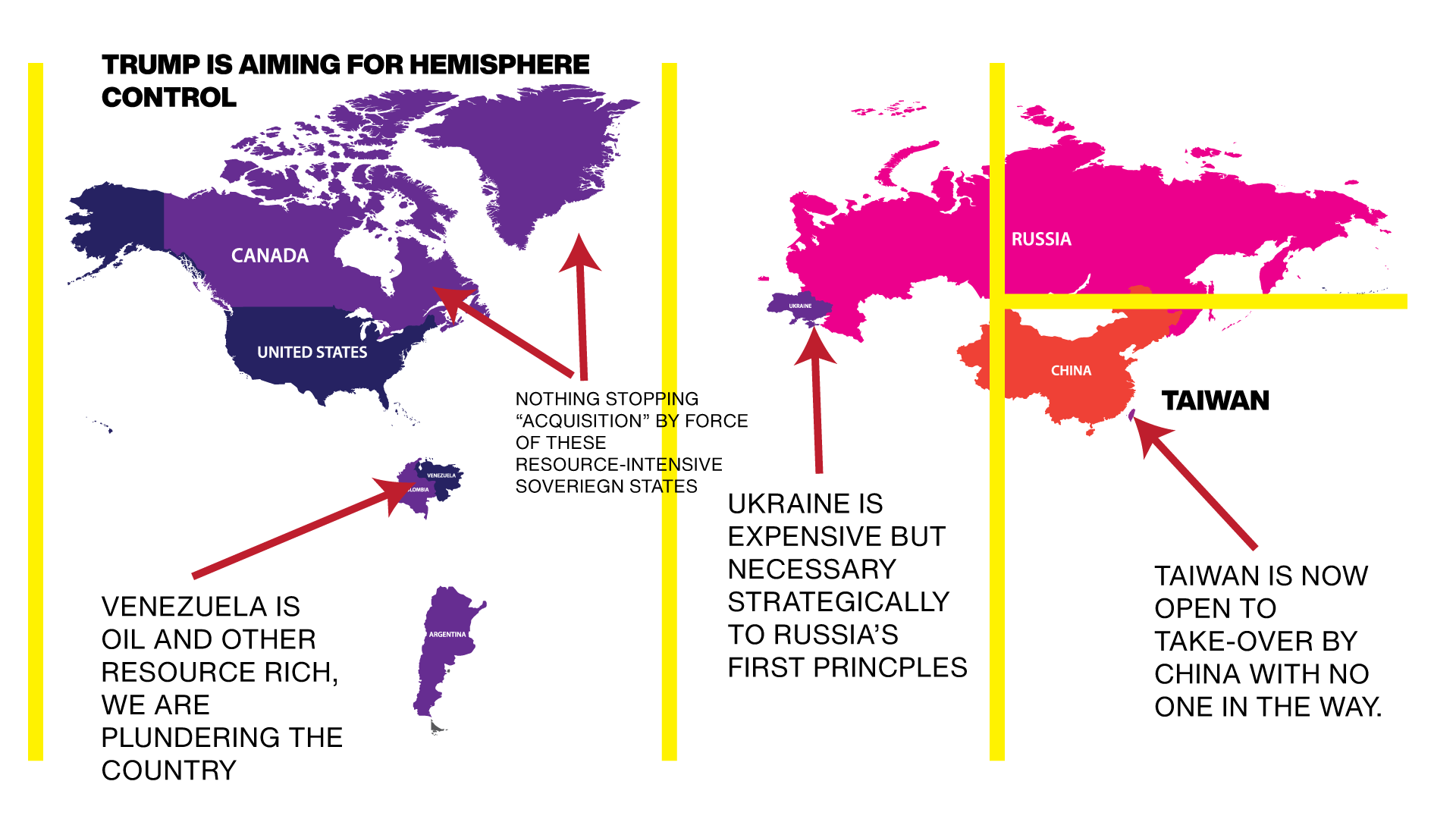
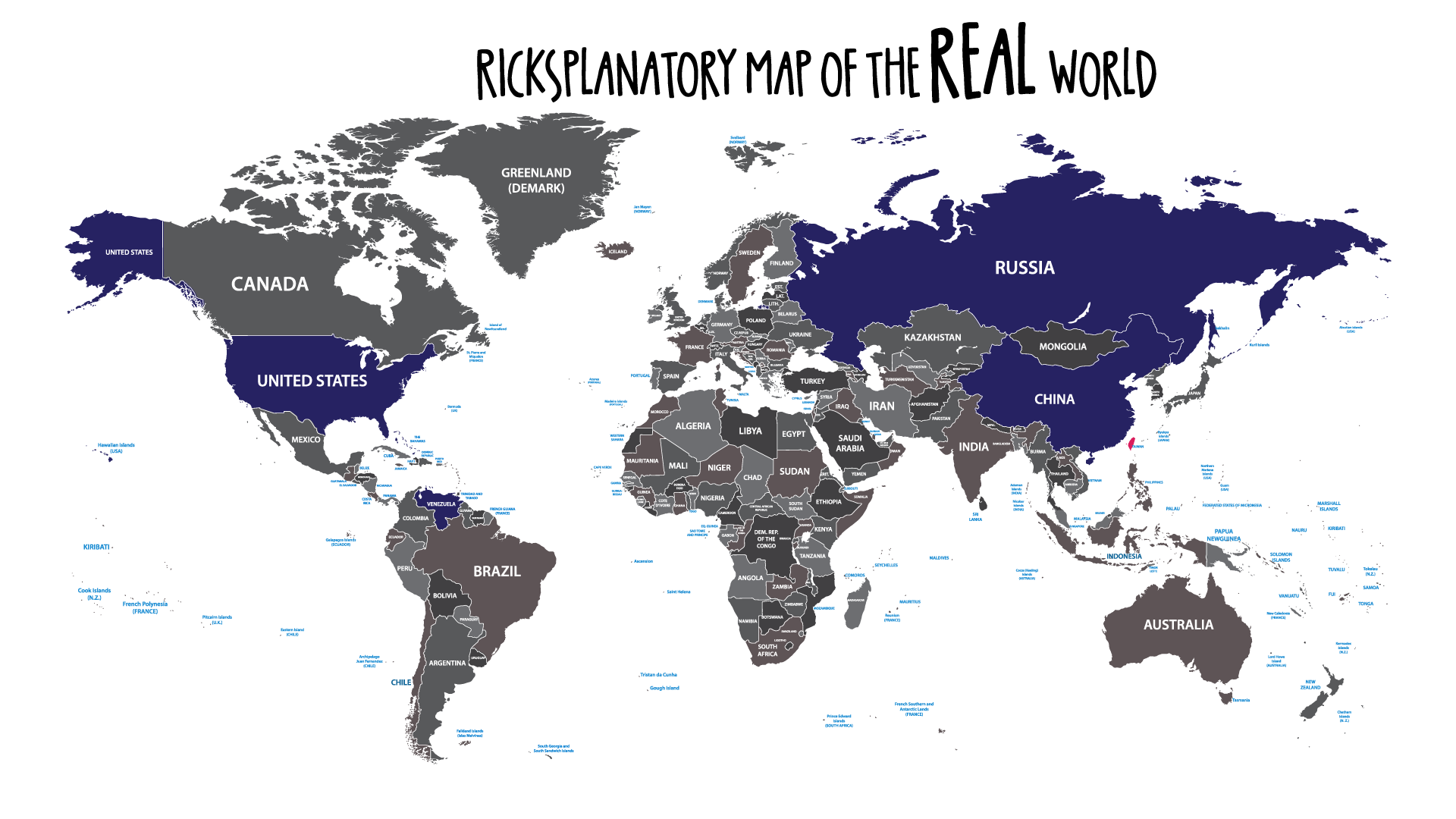
The map below highlights the power structure of 2026. We are inextricably linked now to Venezuela’s fate. Venezuela fuels parts of the South Pacific and Teapot Refineries in China, among other places on the black market. In turn, China has ambitions it can unleash after decades of restraint on Taiwan, which affects everything from the AI bubble to the global consumer television markets – watch that bubble burst! In turn, China is also linked in a two-way relationship with Russia, which is attached to Ukraine and its simultaneous ambition and necessity of ending the war there to expand its extractive, oligarchic-building machine. All of it ties back to us, right here in the United States.
The First Principle: We have always had the elite and the common classes because we inherited them from Europe through our ancestors there. We’ve tolerated the wealth inequity. But when it comes to governance, we want independence, freedom, and the right to pursue what we want, within the bounds of the law. Those are our table stakes, the bare minimum for entry into the game of our society and country.
It’s the social contract that starts and ends with “consent of the governed” by “we the people.” John Locke wrote the ideas down. We implemented many of them, reflecting our Founder’s recognition of the essential Enlightenment concepts Locke explained.
When that process becomes transactional, as it has with Trump in his pay-to-play schemes, and when laws bend toward those who pay the bribes, the social contract frays.
The governed grow rebellious and irritated, followed by angry. Institutions designed to channel discontent peacefully lose their credibility as neutral arbiters. What follows is historically predictable: populist upheaval, sometimes from the left, very occasionally from the right, always chaotic.
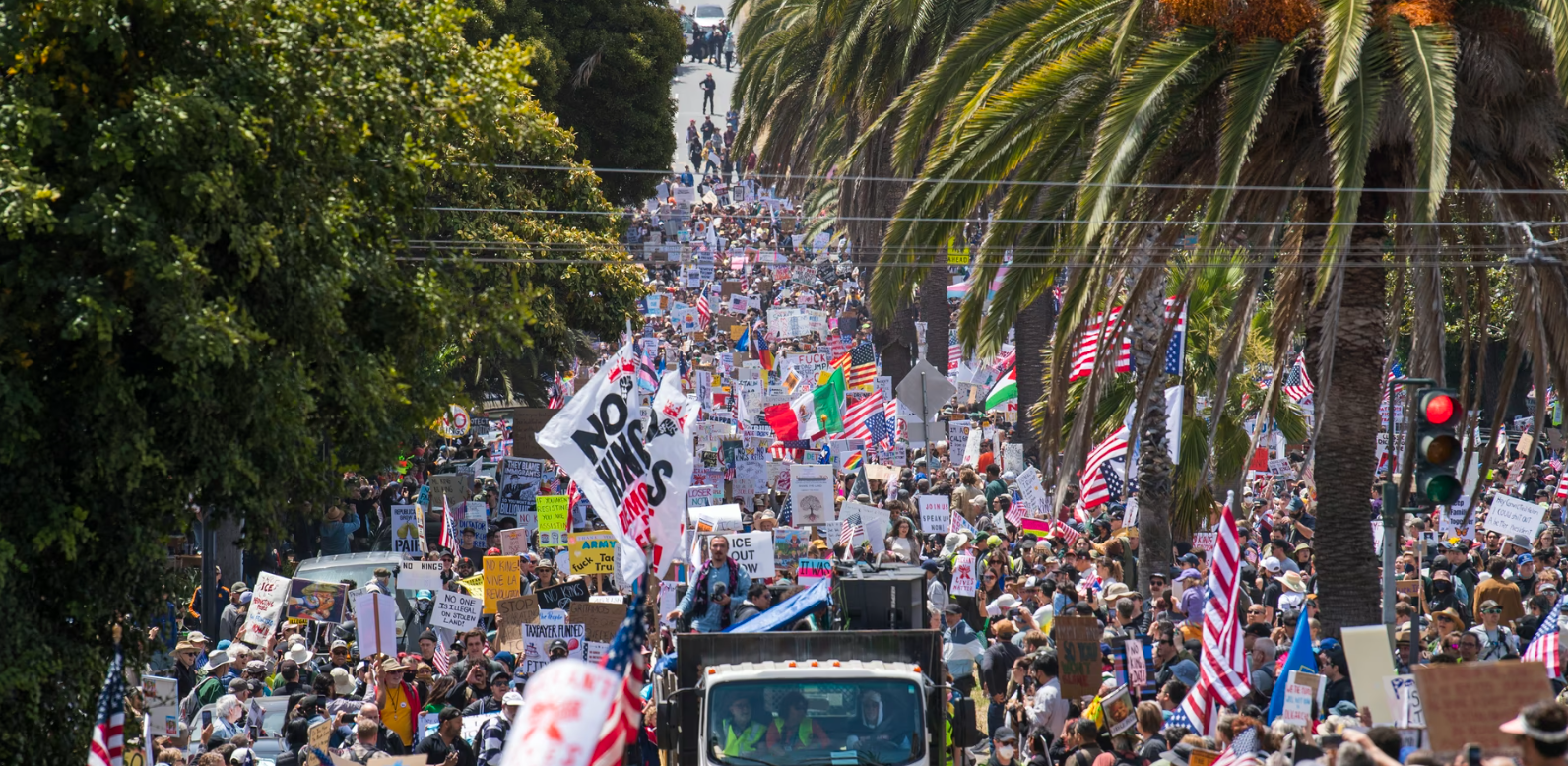
In simple terms, if they try to press their thumb upon us, we will respond with subversive tactics to undermine their regime. That is the reality unfolding in the US right this minute.
Russia: The Endless Cycle
Russian history moves in cycles scholars have mapped with great accuracy: collapse into chaos, reconsolidation under authoritarian strength, territorial expansion, imperial overreach, economic exhaustion, regime collapse. Time after time, this cycle continues.
Proof: The Time of Troubles gave way to Romanov consolidation. Revolutionary chaos produced Soviet reconstruction. The Soviet collapse gave rise to the oligarchic chaos that Putin put in a chokehold. Each cycle features "defensive expansionism"—the logic that vulnerable borders require pushing outward. That’s what’s pushing it to do what it’s doing in Ukraine. Let me explain.
Russia's heartland is an indefensible plain. Mongol invasions came from the east; Napoleon and Hitler from the west. This geography bred justified paranoia and territorial appetite. Under Putin: consolidation, Crimea, full invasion of Ukraine.
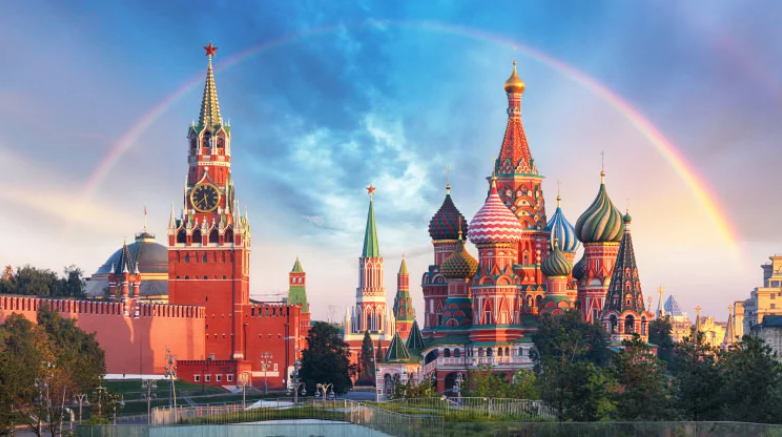
The war has proven costly—over 7% of GDP on defense, hundreds of thousands of casualties. Yet NATO officials warn Russian forces could reconstitute for potential NATO engagement within five to ten years. The Baltic states treat further expansion as an existential certainty.
The First Principle: Russians have historically accepted authoritarian governance because attempts at liberalization, the chaos after communism's end, and the economic devastation of the 1990s brought suffering worse than the predictable constraints of autocracy. The implicit bargain: order and dignity in exchange for freedom. This compact holds until military casualties, economic privation, or elite fracture make it unsustainable. Then comes upheaval—and eventually, another strongman.
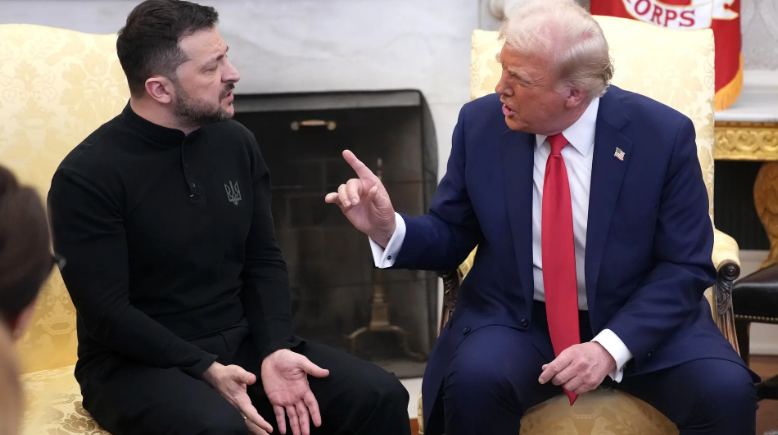
Before we continue, please consider this: Are people of the United States going to adopt a similar mindset towards fascism under Donald Trump’s regime? Or are we still carriers of that revolutionary blood that despises imposed control, in exchange for the sometimes-painful blessings of liberty, happiness, and freedom?
China: The Stability Compact
Modern China's logic requires understanding the century before 1949: it was sustained infighting that led to catastrophes, hindering the country’s economic, social, and fundamental order. Assent to the needs of stability and control by the people, for the people’s own safety, security, and foundational needs, became the regime's fundamental justification.
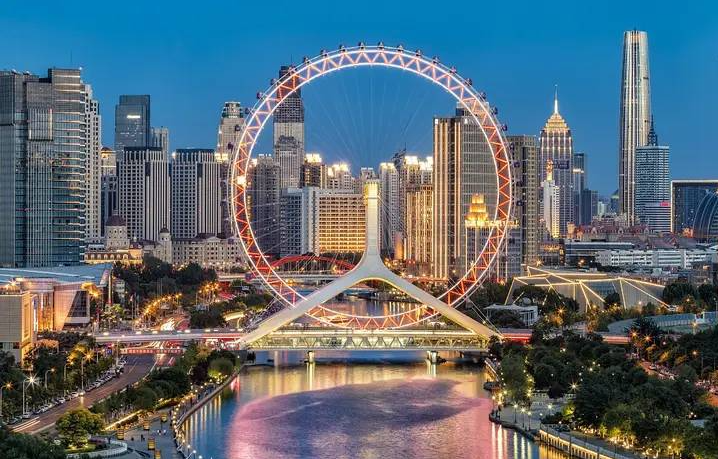
From the Opium Wars through the Japanese occupation, China experienced foreign humiliation, warlord fragmentation, civil war, and famine, killing tens of millions. When Mao declared the People's Republic, the population was exhausted. The Communists leveraged that exhaustion to establish control; its memory remains operative.
The modern social contract in China looks like this: The modern Communist Party (which functions partially within capitalist spheres) delivers economic growth and internal stability; citizens accept surveillance and restrictions on political participation. This differs fundamentally from Western consent, producing a different arrangement rooted in different historical trauma.
Taiwan represents unfinished civil war business and strategic imperative. Control of it by China will give it a path to the Pacific through the "first island chain," provide semiconductor infrastructure and capacity for production, and complete the reunification narrative. In late 2025, China conducted its largest Taiwan-focused exercises while a Japan crisis escalated after Tokyo linked Taiwan's defense to Japanese security. Chinese carriers now operate near Okinawa. For the current year, Japan has approved major increases to its defense budget.
The First Principle: The Chinese compact trades liberty for prosperity and stability. The Party's legitimacy rests on delivering both. Should economic growth stall or internal conflict emerge, the foundational bargain weakens. But as long as memories of chaos persist—reinforced through education and propaganda—the population accepts constraints that Western observers find incomprehensible.
Europe: The Malaise of Post-Empire
Europe defies easy characterization, but "malaise" recurs for reason. The continent that dominated the globe for four centuries struggles with economic stagnation, demographic decline, and security crisis it cannot address alone.
The European project assumed major war obsolete. It focused its resources towards welfare rather than defense. EU nations spend over 25% of GDP on social protection but averaged under 2% on defense. That calculus has collapsed as JD Vance and other MAGA leaders have thrown criticisms at Europe for its lack of investment and payment for its own defense. The new world order is regional and territorial, not principled like it has been since 1945. Europe appears to be asleep at the wheel regarding this fact, while it turns inwards to its own economic problems.
NATO members pledged 5% of GDP defense spending by 2035—levels unseen since colonial wars. Yet finances are stretched: UK debt servicing exceeds £100 billion annually; French officials warn of being "crushed by debt." Military adequacy requires massive borrowing, painful cuts, or unacceptable tax increases.
The EU's "ReArm Europe" plan acknowledges the scale: €800 billion in new investment. Yet fragmentation persists—three fighter programs where one would achieve the goal. The internal bickering seems to drag on while Europe slowly drops its drawers and exposes itself as weak kneed in the face of gathering Eastern threats from Russia. Remember the extractive nature of Russia’s mindset. They see land as buffer, but also as a means to power and further wealth by mining, drilling, cutting, or (lowest) growing commodities like grain on it.
Meanwhile, the Trump regime aligns with Putin rather than the EU. Marco Rubio (Secretary of State) and Vice President JD Vance explicitly speak and put their names on policty that shows reduced commitment, attention shifting to the Western Hemisphere and Indo-Pacific. The November 2025 National Security Strategy, which was warmly received by Moscow (!), says America is ready to hand conventional European defense to Europeans.
The First Principle: Civilizational momentum requires conviction, a belief that better days lie ahead, that sacrifice yields reward. When populations perceive only managed decline, when political leadership offers crisis management rather than aspiration, collective will atrophies like weak, unused muscle. Europe possesses the economic capacity to defend itself. Whether it possesses the political coherence and psychological stamina remains genuinely uncertain.

The View from the Porch
These four sovereign entities, and the countries they’re inextricably linked to: Venezuela, Ukraine, and Taiwan, represent distinct models of state-society relationship under an enormous level of stress. The American democratic contract confronts corruption when it works. Russian authoritarian consolidation grinds through expansion-retraction cycles predictably. Chinese stability holds firm as growth continues. European welfare-state equilibrium faces military demands it was designed to avoid.
What distinguishes this moment is simultaneity—all four arrangements tested at once, in an interconnected system where each trajectory affects the others. American disregard for the rule of law and the end of its role as a global police force signal to Beijing we’re in decline and moving towards isolationism. Russian resilience informs European calculations. Chinese pressure on Taiwan will likely not give rise to a bloody conflict, but rather signify a quiet surrender and transfer of power that has had a gravitational pull for six decades.
The “big dogs” in post-American Superpower status are starting to take shape. We’re just waiting to see which one bites the other first.
That's a Wrap
I've written to cover a lot of topics today, all interconnected. Thank you for reading! I appreciate it.
As I close most of my articles written daily, I would like to remind you and ask you to consider your mental health. It's the foundation in all our lives that shapes our physical and spiritual health. Please consider unplugging from your digital footprint today for an hour, and spend that time focused on something very physical: A book, a walk, staring at a painting - literally anything that grounds you to here and now. It can be very helpful!
The fight ahead is going to be long. We need YOU to be here for it, which is why taking care of yourself is so important. Help yourself, and help all of us out!
Be Well.
Rick Herbst
January 5, 2026
Author
Sign up for Lift Up Democracy newsletters.
Stay up to date with curated collection of our top stories.