The Farmer Who Backed the Tariffs, and Now Has to Survive Them
Commodity agriculture is structurally dependent on global markets, and trade policy that is unstable or poorly sequenced transfers risk onto producers like Caleb
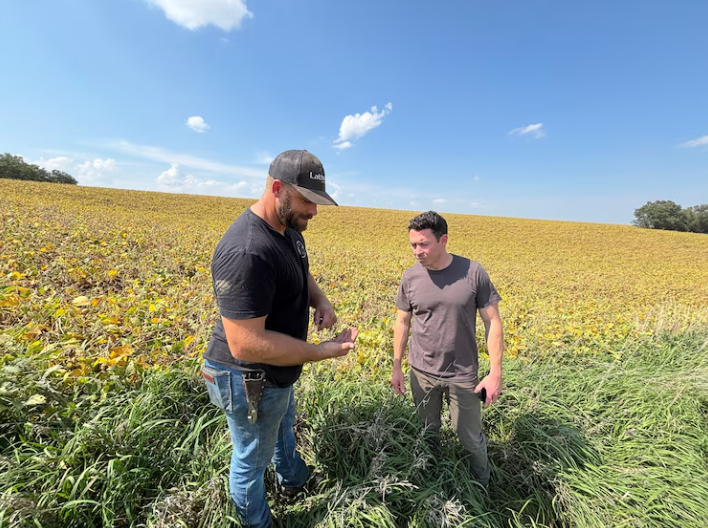
Soybeans are a good case to start an examination of the counterintuitive logic MAGA farmers have applied to their situation, and that has left them burned. Their industry is structurally export-dependent. U.S. producers export roughly half the crop in a typical year, and China has been the most critical buyer, often taking about a quarter of total U.S. production. When that relationship breaks, the loss does not remain an abstraction. It lands in rural balance sheets.
Caleb Ragland, a Kentucky soybean farmer and the president of the American Soybean Association, has become one of the most visible voices trying to describe what this looks like from the inside. He has also voted for Donald Trump in every election since 2016, and has supported a tougher trade stance. He is not describing a policy imposed by opponents. He is describing the consequences of a strategy he expected to work, and that now threatens farms that do not have room or time for prolonged volatility.
Caleb Ragland’s job is to translate market failure into plain language.
Ragland farms near Magnolia, Kentucky. Reporting on the soybean trade dispute describes him as running a large family operation with a generational horizon, and as someone trying to keep a ninth-generation farm viable long enough for his sons to inherit. His formal role, as president of the national trade association for soybean producers, is to push for market access and stable trade rules. His informal role, in this moment, is to explain to policymakers and voters what happens when trade policy is treated as improvisation.
That explanation has repeated themes.
One is timing. Farmers plan a year, sometimes more. Planting decisions, input purchases, equipment financing, and land rent commitments are made long before harvest. When a trade fight escalates after those commitments are locked in, the farm cannot simply pivot. This is why the phrase “bridge payments” shows up in federal relief plans. USDA’s December 2025 announcement of a $12 billion Farmer Bridge Assistance program explicitly states that it is temporary support tied to trade disruption.
Another theme is scale. A family operation can be large in acres and still behave like a small business in terms of risk tolerance. It can carry debt, rely on seasonal operating credit, and live close to the margin even when the farmer looks asset-rich on paper. Land is not cash. Grain in a bin is not cash. Banks and suppliers still expect payment.
When a farm leader starts speaking publicly about “end of the rope” dynamics, it is a sign that the problem is no longer just a price chart. It is liquidity, debt service, and the lender's extension of credit for the next renewal.
What changed in 2025: tariffs, retaliation, and a market that moved on
In 2025, the Trump regime imposed a new round of broad tariffs, and China retaliated by targeting agricultural leverage. Reuters reported that China suspended import licenses for several U.S. firms and imposed additional tariffs on soybeans, part of a wider retaliation package tied to U.S. trade-war behavior. Associated Press reporting described China’s effective boycott of U.S. soybeans as a deliberate pressure point because farmers are a politically salient constituency.
This matters because soybeans are unusually exposed to a single buyer. AP reported that in 2024, the U.S. exported nearly $24.5 billion in soybeans, with China accounting for more than $12.5 billion of that total. When China stops buying, the U.S. supply does not disappear. It has to clear somewhere else, or it sits in storage while farmers wait for a bid that fits their profit-loss financial reality.
The replacement problem is structural. Industry leaders have been blunt that China cannot be replaced quickly. China also has leverage because it can shift to Brazil and other suppliers, and because it has spent years reducing dependency on U.S. beans.
There was movement late in the year. Reuters reported a tentative trade agreement under which China agreed to purchase 12 million metric tons of U.S. soybeans through January 2026, with additional forward commitments under discussion. That is relief, but it is also an admission of the core vulnerability: farms are being asked to survive on partial restoration while the broader relationship remains unstable.
The per-acre math is what turns “trade strategy” into a personal crisis
The key number that keeps recurring is the per-acre loss.
In October 2025 testimony, Ragland’s association cited an ASA economic analysis that projected soybean farmers would incur a $ 109-per-acre market loss on the 2025 crop under the combined pressure of high production costs and trade-related market losses. The same testimony warned that a quarter of U.S. production might need to find new customers if China’s market remained effectively closed.
Per-acre losses sound technical until they are multiplied across a real operation. A Kentucky farmer with 1,400 acres of soybeans, like David Winchell in Hawesville, is not looking at a marginal hit. He is looking at a system where a thin profit year becomes a loss year, and a loss year becomes a credit event. Local reporting described Winchell’s exposure as tied to both market pricing and rising input costs, including equipment expenses that small and mid-sized operators finance over time.
That dynamic shows up across the region. Reuters reported that Kentucky farmers in 2025 were also hit by historic flooding that disrupted planting, forcing repairs and delaying decisions during a tight window, while soybean prices remained weak under trade pressure. It is a compounding problem: trade disruptions reduce revenue certainty, and weather shocks increase costs and operational risk.
Why the bailout exists, and why it does not solve the underlying problem
The Trump administration’s response has leaned on aid packages framed as temporary relief. Politico reported the administration’s planned $12 billion bailout, with most funds targeted to major row crops, including soybeans, and disbursement expected to begin in February 2026. USDA’s program announcement describes bridge payments tied to 2025 acreage reporting, with commodity-specific rates to be released by the end of December and payments expected by late February 2026.
This is the core contradiction that farmers repeatedly point to. Many do not want to be paid to endure bad policy. They want markets that allow them to operate profitably. AP captured that preference clearly through interviews with farmers who described “aid payments” as something they would rather avoid, in favor of predictable trade rules and customers.
A bailout can cover a cash-flow gap. It does not rebuild market share. It does not reverse buyer substitution. It also does not resolve the credibility problem created by unpredictable shifts in tariff rates and policy intent. If the operating assumption is that the next tariff announcement could arrive at any moment, lenders price that uncertainty. Suppliers price it. Landlords price it. The farm pays for it.
There is also a political economy issue. When an administration claims tariffs bring in “hundreds of billions” and simultaneously needs taxpayer-funded bridge programs to prevent farm failures, it creates public confusion about who pays for tariffs and who receives the proceeds. The result is a policy environment that can reward optics over accounting clarity.
The quiet accelerant: consolidation and the shrinking room for error
The tariff fight is not happening in a neutral market. Even without tariffs, agriculture has been consolidating for decades. The practical effect is that the farmers who disappear are often replaced by larger operators, or by landlords and management structures that can tolerate volatility through scale, diversified revenue, and better access to credit.
This is why “corporate agriculture” is part of the story even when the immediate crisis is trade policy. A market can be highly efficient yet still fragile for small operators. If the price is set globally, and if concentrated input markets increasingly influence the farm’s costs, there is limited room for a small producer to outmaneuver a systemic shock. The farmer becomes a price taker on both ends.
Trade disruption accelerates this. It forces farms to sell into weaker markets or hold inventory longer, increases borrowing needs, and raises the probability of a forced sale. That is how policy volatility becomes a consolidation engine, even if no one states it that way.
The human edge of the balance sheet
When farm income collapses, stress rises. That is not a political statement. It is a predictable response to debt, uncertainty, and a sense of losing control over a business that is also a home and a legacy.
Some elected officials and farm advocates have referenced the 1980s farm crisis as a warning about mental health consequences when financial distress becomes widespread. The Washington Post reported that Senator Chuck Grassley drew a comparison to that period, including references to farmer suicides during the crisis. (The Washington Post) The point here is not to argue that 2025 is a repeat. It is acknowledged that prolonged economic distress has downstream effects that a relief check does not automatically fix.
In this environment, Ragland’s comments have carried weight because they are framed as operational reality rather than ideological grievance. When a trade association president says the industry is in emergency conditions, it signals that the normal buffers are failing.
What this case demonstrates, and what it doesn’t
This Kentucky soybean case is not evidence that farmers are naive or that rural America is uniformly aligned on policy. It is evidence of something more basic: modern commodity agriculture is structurally dependent on global markets, and trade policy that is unstable or poorly sequenced transfers risk onto producers who have limited flexibility once a season is underway.
It also demonstrates how quickly a political narrative can collide with administrative capacity. A tariff strategy that treats pressure as an end in itself can generate retaliation faster than it creates leverage. When that happens, the administration is left with a familiar tool: public reassurance and emergency aid. That can prevent immediate collapse for some operators. It does not restore the underlying market structure that made soybean farming viable at scale in the first place.
For readers evaluating competence, the question is simple. When a policy predictably causes concentrated harm to a known constituency, and the mitigation plan is improvised after the damage is visible, the problem is not ideology. It’s governance.
Notes on direct quotes from Caleb Ragland
- “This is a five-alarm fire for our industry.” AP News
- “Every day without an agreement further erodes U.S. farmers’ market share in China.” American Soybean Association
- Congressional testimony excerpt referenced by The Washington Post, including the $109 per-acre estimate and the warning that a quarter of U.S. production may need new customers.
Author
Sign up for Lift Up Democracy newsletters.
Stay up to date with curated collection of our top stories.