Western Iowa Farmer, Global Tariffs, and the Limits of Market Control
The rapid escalation of tariffs and the chaotic implementation of relief programs create a sense that agricultural policy is improvised rather than structured.
Tension Between Policy and Market Reality
Agricultural markets are among the most transparent of American industries. Trump’s tariff war has only made this fact more visible in recent weeks. The commodity markets for corn, soybeans, and other major crops are sensitive to changes in global trade flows, supply expectations, and demand forecasts. Price risk is managed continuously through futures contracts and other instruments precisely because producers know that what happens on the global stage will show up quickly in local revenue streams.
Tariffs are a blunt instrument. When Trump’s regime imposed them as part of a broader strategy, the intention is often to reshape the terms of trade. The lived result, particularly for independent producers, can be market disruption, with little room to adjust production decisions set long before tariffs were announced. This is the context in which Eric Euken, a seventh-generation farmer in western Iowa, finds himself. His case illustrates how specific policy choices can translate into operational uncertainty and financial stress for family farms that cannot alter their operations for years to come.
Meet Farmer Eric Euken
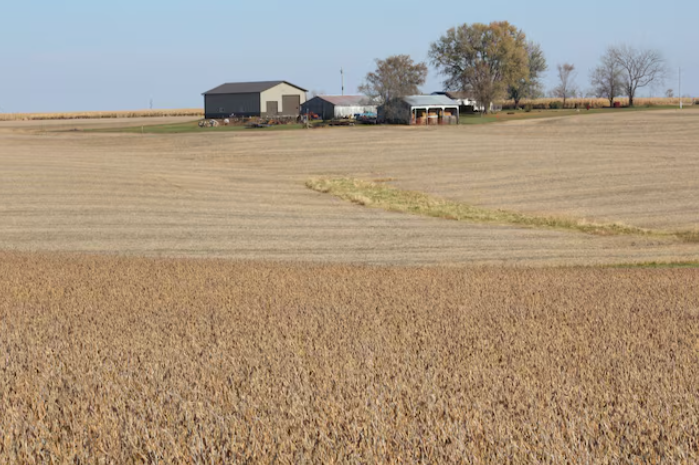
Eric Euken operates a mixed farming enterprise near Wiota, in western Iowa. His livelihood spans crops and livestock. He grows roughly 750 acres of corn and 600 acres of soybeans and also raises pigs and cattle. He is a seventh-generation farmer on land that has been in familial production for decades. This historical continuity shapes his understanding of risk and his expectations of market access and stability. It also informs his sense of attachment to place and responsibility to future generations.
In 2024, he voted for Donald Trump, partly because of the president’s stated commitment to a tougher trade stance. For producers like Euken, the appeal lay in the promise of stronger export access and greater leverage against trading partners perceived as having unfair advantages. The result of the 2025 tariff escalation has been very different from what he anticipated. As he explained in a 2025 interview, “We don’t know what’s happening next from day to day,” and “I didn’t anticipate it being as bad as it is.” These reflections go beyond theoretical risk. They speak to an operating rhythm in which weekly and seasonal decisions carry real financial consequences.
Market Dislocation and Operational Stress
The introduction and escalation of tariffs in 2025, particularly against China and other trade partners, have had immediate and quantifiable effects on commodity markets. China, historically the largest buyer of U.S. soybeans, significantly reduced purchases after retaliatory tariffs were applied, leaving an immediate surplus of U.S. beans seeking alternative markets. That surplus pressure has contributed to lower domestic prices and reduced revenue for crop producers who depend on export demand. [Reuters and AP reporting indicate that the U.S. soybean export market contracted sharply in 2025, and farmers have lost billions in export value.]
For Euken, livestock production has mitigated some of the revenue shortfall from corn and soybeans this year. Where grain prices have weakened under trade pressures, cattle and pigs have provided some internal offset. This juxtaposition highlights a structural difference between diversified farms and more specialized operations. However, livestock margins are not large enough to make grain market disruptions inconsequential. In Euken’s assessment, the uncertainty created by tariff policy has been so pervasive that even a diversified operation cannot plan with confidence beyond a few weeks.
The Policy Shock versus Routine Agricultural Decision Cycles
A farm operator’s planning horizon is measured in seasons. Inputs such as seed, fertilizer, and land rent are committed months before planting. Machinery purchases and debt service are structured on multi-year amortization. When a market shock arrives mid-cycle, producers cannot simply change course without incurring high costs. The uncertainty that Euken describes “from day to day” is precisely the disconnect between a government’s policy timing and the agricultural calendar.
Tariffs announced with limited notice and layered onto existing trade tensions create a cascade of effects: importers pause commitments, buyers substitute suppliers, and commodity prices decline. The loss of market access for soybeans and downward pressure on corn prices ripple through farm balance sheets and operate independently of domestic livestock margins. This dynamic is well recognized among agricultural economists because export markets account for a significant share of U.S. production. When one major buyer retreats, the supply must clear elsewhere at a price that reflects excess inventory rather than domestic cost structures.
A Bailout That Stays Short of Market Restoration
By December 2025, the Trump administration announced a $12 billion aid package for farmers affected by tariffs and elevated input costs. That package includes roughly $11 billion aimed at row-crop producers, including corn and soybean growers, with the rest reserved for specialty crops. It is designed as a “bridge” to help farmers carry operating costs into the next season while broader policy changes take effect.
This assistance arrives late in the cycle for many. Farmers must make critical decisions about seed purchases, fertilizer contracts, and equipment before disbursements are scheduled. More fundamentally, a short-term aid program cannot recapture lost export demand. A revenue gap created by shrinking global markets cannot be filled by cash transfers alone. Farmers and farm advocates have observed that the aid will not fully compensate for steep losses, which Reuters estimates could total between $35 billion and $44 billion this year for major commodity crops.
The policy framing around this aid also underscores its limitations. USDA officials have said the package is a temporary fix until enhanced farm support structures, such as raised reference prices under new legislation, take effect in late 2026. It is not presented as an immediate restoration of market access.
How Big Agriculture Interacts With This Shock
Large agricultural producers and integrated operations have more tools for managing volatility. They can leverage scale, access hedging markets more effectively, and negotiate supply contracts with diverse buyers. They have deeper balance sheets and often have access to equity and debt markets that smaller operators do not.
For independent farms like Euken’s, these tools are more limited. The tariff-induced export contraction removes a significant pricing signal from the market. Without sufficient alternative demand, prices compress until global buyers reenter at lower quantities or domestic consumption absorbs the excess. Small and mid-sized producers cannot wait indefinitely for market adjustment. Their cost structures are less flexible, and debt obligations come due regardless of whether the crop sells at a price that covers production costs.
Uncertainty and Confidence in Governance
For Euken, the question is not only economic. It is about the predictability of governance. The rapid escalation of tariffs and the chaotic implementation of relief programs create a sense that agricultural policy is improvised rather than structured.
One consequence is that farmers make future decisions under the shadow of uncertainty. A futures market reacts to expected supply and demand, but when the policy axis shifts unpredictably, even futures prices become unreliable signals. A diversified producer may mitigate some risk with livestock, but the fundamental condition remains: when policy affects demand more than supply, prices fall, and farms built on thin margins feel the effects first and most acutely.
What This Case Reveals
Eric Euken’s experience is not unique geographically or by commodity. It reflects a broader pattern in which national trade policy collided with global market responses in a way that weakened demand for U.S. exports. For a family farm, that is not abstract. It affects cash flow, debt management, and the decision to remain in business.
This case does not prove that tariffs are always bad. It shows that policy implementation without clear sequencing, predictable timelines, and comprehensive risk analysis can destabilize sectors that are tightly coupled to global markets. It also shows that short-term financial aid does not substitute for restored market relationships. For professionals assessing policy competence, the lesson is structural: governance requires alignment between policy objectives, institutional capacity, and predictable effects on economic actors. When that alignment falters, producers face the consequences in measurable terms.
Author
Sign up for Lift Up Democracy newsletters.
Stay up to date with curated collection of our top stories.